
Roscommon’s park overhaul features a rare paved “pump track”
An $820,000 grant from the state’s Land and Water Conservation Fund to the Roscommon Area Recreation Authority funded upgrades to the former Metro Park.
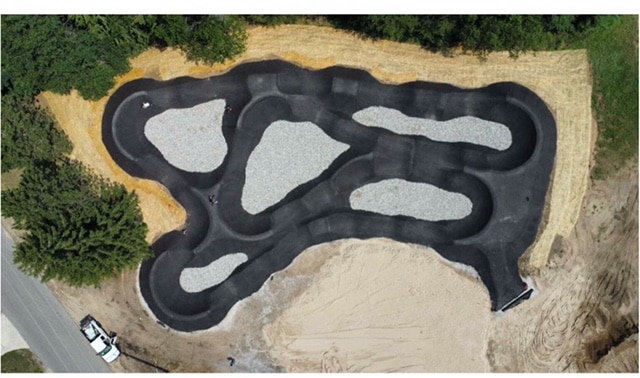
A quiet village park in Northern Michigan has been transformed into the region’s go-to spot for active families, thanks to the addition of a 21,000-square-foot paved “pump track,” a specialized pathway designed for any device on wheels, including bikes, scooters, skateboards and wheelchairs.
An $820,000 grant from the state’s Land and Water Conservation Fund to the Roscommon Area Recreation Authority funded upgrades to the former Metro Park, on George Street on the village’s southeast side. The changes were so significant that the park has been aptly renamed Roscommon Community Park and Pump Track.
“This pump track— there’s only a handful of those in Michigan,” says Roscommon Village Manager Ron Alden. “Kids are just flooding the area.”
What’s happening: Thanks to an $820,000 grant from Michigan’s Land and Water Conservation Fund, Roscommon was able to make improvements to the former Metro Park and create a pump track. The park is now known as the Roscommon Community Park and Pump Track.
What is a pump track: Unlike traditional trails or bike paths, a pump track is a skills course that allows anyone on wheels to ride a circuit of bumps and banked turns. A pump track is designed in a continuous loop circuit of intentional bumps, called rollers, and banked turns, called berms, that allow users to generate speed by “pumping”— going up and down the features — instead of pedaling a bike or pushing with a foot. They are designed for wheeled devices such as bikes, skateboards, and scooters, and are considered fun for various skill levels. In addition, the tracks are intended to encourage balance and control skills.
Public response: The park’s new free paved circuit is so popular there were already “probably a dozen kids” using it during the November ribbon cutting ceremony to celebrate its addition to the village, Alden says. Though it’s available for users of any non-motorized device on wheels, bikes seem to be the ride of choice, Alden says, and the village even provides a variety of bikes, helmets, and safety pads for park visitors who want to try it but don’t have bikes of their own.
Other improvements: Although the pump track is the hot attraction in the summer, it’s far from the village’s lone recreational upgrade. Other recent improvements include a basketball court, relocation of the parking area to improve traffic flow and access to park amenities; ADA parking spots; a 35-foot-by-35-foot covered patio— also ADA accessible— with picnic tables, and a 6-foot-wide hard surface pathway that is barrier free. All of these areas are interconnected with sidewalks and benches placed throughout the park area.
In addition, a May ribbon cutting celebrated “a 40-foot-by-80-pavilion that went up for our farmers market,” where the Roscommon Area Recreation Authority has currently situated an ice skating rink for the winter, Alden says. And in October, the village unveiled its upgraded kayak launch on the AuSable River, a project included in funding from a $1.5 million grant from the Michigan Economic Development Corporation. “This (improved launch) allows you to set your boat down, and when you’re all set, get in, and the boat would be on rollers, and then it rolls right down into the water,” Alden says.
Background: Situated on the banks of the AuSable River, Roscommon, home to about 1,000 people, has long been recognized for outdoor activities such as canoeing, fishing, and the presence of the rare and protected Kirtland’s Warbler. The village’s Metro Park was the first holding of the Roscommon Area Recreation Authority in 1970; 20 years ago, the park featured a pavilion, accessible restrooms, three ball fields, picnic area concession, storage facilities, and parking.
Thanks to funding from various community groups, including the Roscommon Rotary, Little League, Roscommon Lions Club, Zonta, Weyerhaeuser, as well as other donations, improvements were made over the yearr. In 2013, the aging tennis and basketball courts and old playground were replaced by a modern, accessible playground three times the size of the original space.
Related Articles
New multi-purpose pavilion rising in Beaverton
When completed, the 80-foot-by-100-foot structure could also be used to host farmers’ markets and other community events.
The Strickler Center in Central Michigan combines efforts to make a difference
Six nonprofits. One roof. Thousands of neighbors served. The Strickler Center in Mt. Pleasant makes it easier for neighbors to help neighbors. Plus, WCFX’s annual Caravan of Care returns through Jan. 30. Here’s how it all works—and how you can be part of it.
New Life in Old Halls: Transforming Finlandia University’s former buildings for a vibrant future
Most of the university’s buildings have been sold. Some are being renovated into apartments and commercial space. Others will become event venues and a community hub.