
Keeping an eye on ships crossing the Straits of Mackinac
The Enbridge Straits Maritime Operations Center monitors ships passing through the Straits to make sure anchors are properly secured.
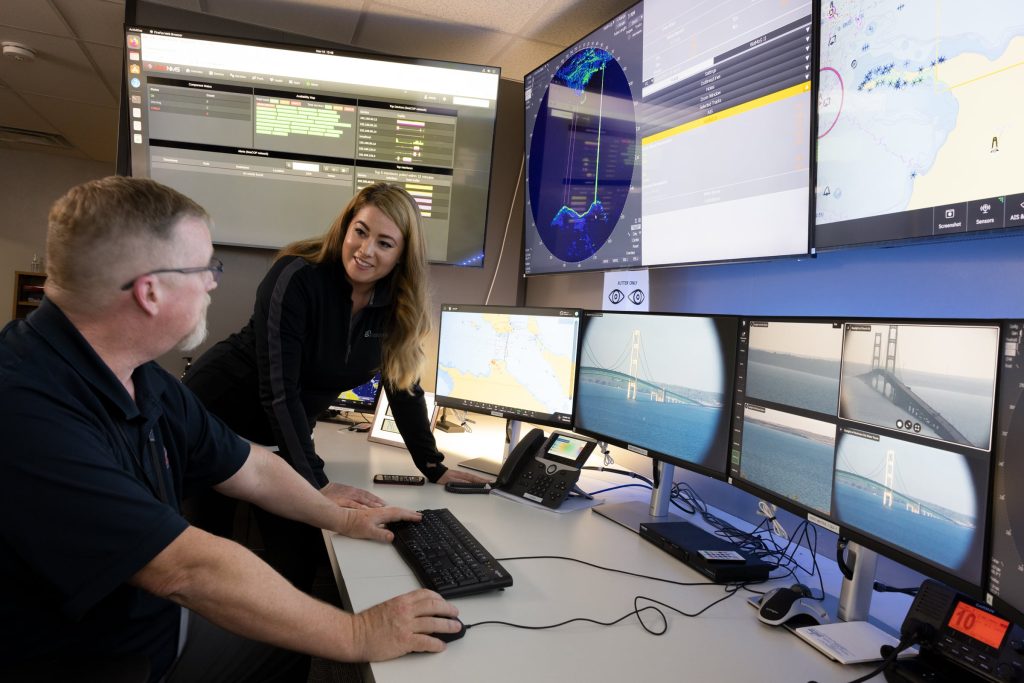
From an odd-shaped building tucked off of U.S. 2, not far from the sandy shores of Lake Michigan, a skilled team monitors – around the clock – the freighters and other vessels crossing the scenic Straits of Mackinac.
The team at the Enbridge Straits Maritime Operations Center oversees a variety of marine traffic safety systems designed to prevent an anchor strike on the dual pipelines – known as Line 5 – anchored to the lakebed of the Straits.
Essentially, the Enbridge team is monitoring a no anchor zone. Vessels are prohibited from anchoring or loitering in the zone without advance permission from the U.S. Coast Guard. It’s kind of an invisible electric fence around the Straits.
An anchor strike is the biggest threat to the pipeline. A strike could rupture the pipeline, causing environmental damage to the water, as well as disrupting the transportation of energy.
Line 5 transports light crude oil and natural gas liquids from Wisconsin to Sarnia, Ontario, Canada, where they are refined into propane. The pipeline delivers 65 percent of the propane that heats homes in the U.P., and supplies 55 percent of Michigan’s propane needs, according to the Canadian-based multinational and energy company.
In any given year, some 2,500 vessels pass through the Straits. That number can be as many as 21 or 22 on a single day.
Opened three years ago, the state-of-the-art operations center provides an unprecedented level of marine monitoring capability. Along with a well-trained staff, computers and technology play pivotal roles in protecting the pipeline and the waters of the Great Lakes.
“It’s been a great asset. We purposely built a one-of-a-kind operation,” says Mike Davanzo, a maritime operations specialist who is in charge of the Enbridge center. “We’re essentially watching the big boats go by and making sure they’re aware of the submerged pipeline.”
Other safety measures include radio contacts to passing vessels to confirm anchor positions, as well as seven high-definition cameras installed at strategic spots. The staff has their eyes on all angles of the narrow waters around the bridge and between the upper and lower peninsulas.
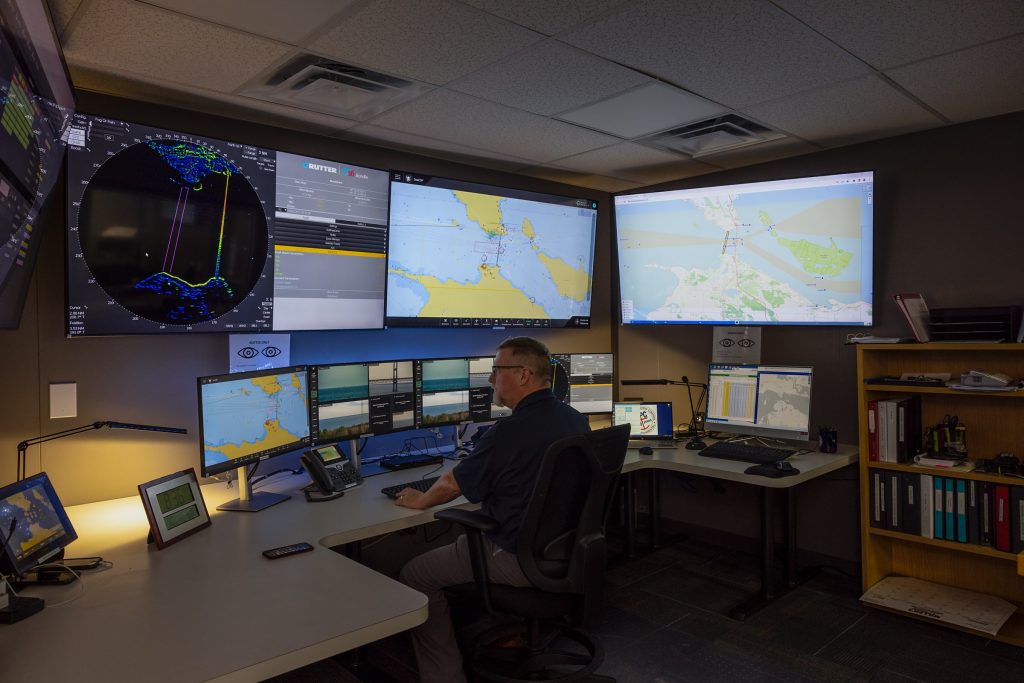
In addition, other radar, and weather monitoring tools are in place to track wind speed and wave heights, which could adversely impact ships – and ultimately increase contact with the pipeline. Emergency response boats are available, if needed.
“It’s a really unique operation that’s done in only one place in the world — right here in the Straits of Mackinac,” says Davanzo, who is a retired U.S. Coast Guard captain. “We have our eyes on the water 24 hours a day, seven days a week.”
The submerged pipeline line starts underground onshore, tapers deep underwater and crosses the Straits for about four miles. The pipeline rests on the lakebed, at a depth of at least 65 feet.
Although Enbridge maintains the pipeline, in operation since 1953, is well protected by a thick coating and its anchoring to the lakebed – as well as the company’s 24-hour monitoring – plans are moving forward to replace the aging pipeline.
To further protect the transport of energy supplies across the Straits, Enbridge hopes to break ground next year on a replacement pipeline – one that will be buried beneath the lakebed in a tunnel.
The construction of the Great Lakes Tunnel will add extra layers of safety and environmental protection making a safe pipeline even safer, eliminating the risk of an anchor strike and the potential of any liquid release, Enbridge officials said.
The pipeline will be encased in concrete and buried deep below the lakebed. The tunnel also will be able to accommodate other utilities, such as fiber optic cables for improved internet connectivity.
That project is expected to cost hundreds of millions of dollars and will be the largest infrastructure investment in the U.P. and Northern Michigan in decades.
Safety center
Since Enbridge opened the operations center on the site of a former wax museum in 2022, there haven’t been any close calls with anchors.
“We are really proud of what we do. We are blessed with great people,” Devanzo says. “Everyone has a passion for the Straits. There’s a lot of skill and passion here committed to protecting the Straits.”
There was a mishap with an anchor several years ago, before Enbridge’s initial maritime operations center opened.
In early spring 2018, a ship passed through the Straits unknowingly dragging its anchor. The anchor bounced off the pipeline but caused no significant damage – there were no leaks of liquids. An electric cable owned by another company was ripped out.
The incident, however, prompted Enbridge to hasten the construction of the marine safety center and expand its safety program.
What’s ahead
Over the past several years, the Great Lakes Tunnel Project has undergone extensive government and public review. The Michigan Public Service Commission has granted approval for Enbridge to relocate that segment of Line 5.
Currently, Enbridge is awaiting the necessary permits from the U.S. Army Corps of Engineers and the Michigan Department of Environment, Great Lakes and Energy.
The project, however, has not come without public concern and criticism.
Various environmental groups, tribal nations and other organizations have raised concerns about the environmental impact during the construction of the tunnel, including short-term air and noise pollution, and increased traffic. Concerns also have been voiced about the design of the tunnel, continued use of fossil fuels and the potential for long-term damage to the Great Lakes. Some opponents have pursued legal action against the project.
To quell concerns and share information about the tunnel, Enbridge opened an informational center in downtown St. Ignace in 2021. The center shares the history of Line 5, the geography of the Straits and plans for the project. In addition, there is a miniature display of the machine that will bore through the Earth to build the tunnel.
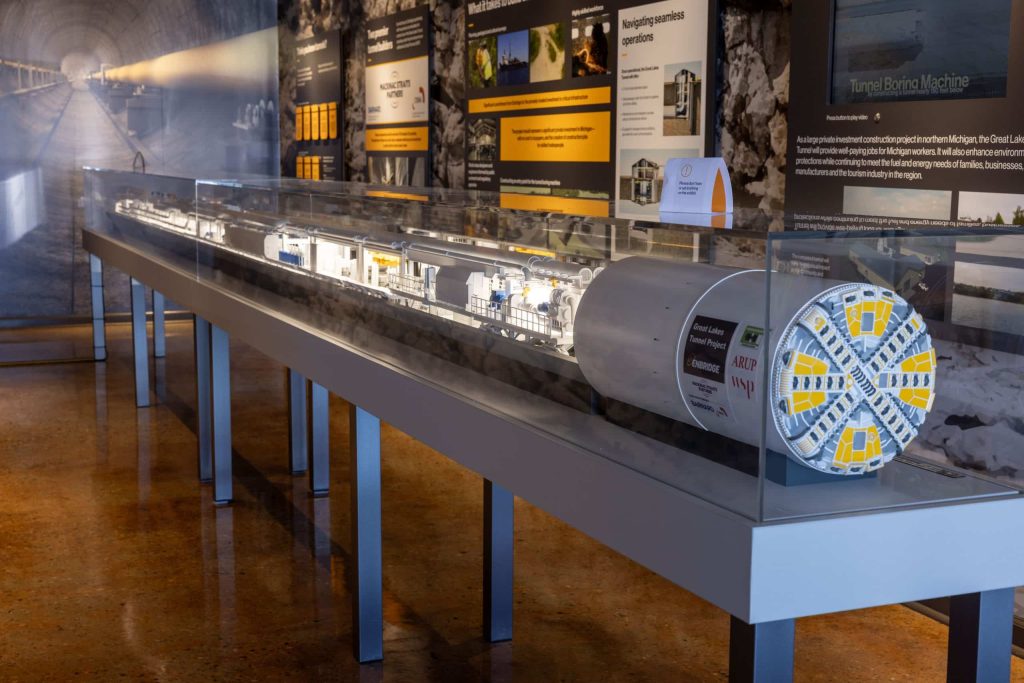
Once the tunnel is completed, the maritime operations center will no longer be needed by Enbridge. Over the past few years, the center has worked with other law and safety agencies over the years, including during big events such as the annual Mackinac Bridge Walk.
Could the maritime operations center find another use as a regional marine safety center for the Straits?
.
Author

Related Articles

RV marketplace startup wins First Place at TCNewTech pitch competition
TCNewTech is a recurring pitch competition supported by tech enthusiasts, businesses, and entrepreneurs.

Closing the digital gap: High-speed internet to reach all of Midland County by 2029
High-speed internet access is expected to reach every household in Midland County by 2029, opening the door to better access to education, healthcare, and employment across the community.
Partner Partner Content Enbridge’s St. Ignace center offers details about the Great Lakes Tunnel
The Great Lakes Tunnel Information Center provides the community with information about Enbridge’s plan to build a tunnel under the Straits of Mackinac.