Small Town, Big Heart: Freeland Fabricators build more than robots
In the “Bot Cave,” the Freeland Fabricators are building more than a robot. They are building confidence, leadership, friendships and a sense of purpose. While the team has earned international recognition in FIRST Robotics, students say the real impact goes far beyond competition, shaping who they are and how they show up for their community.
In a workshop affectionately known as the “Bot Cave,” the Freeland Fabricators are doing far more than building a robot. They are building confidence, friendships, leadership skills and a culture of service that reaches well beyond competition day.
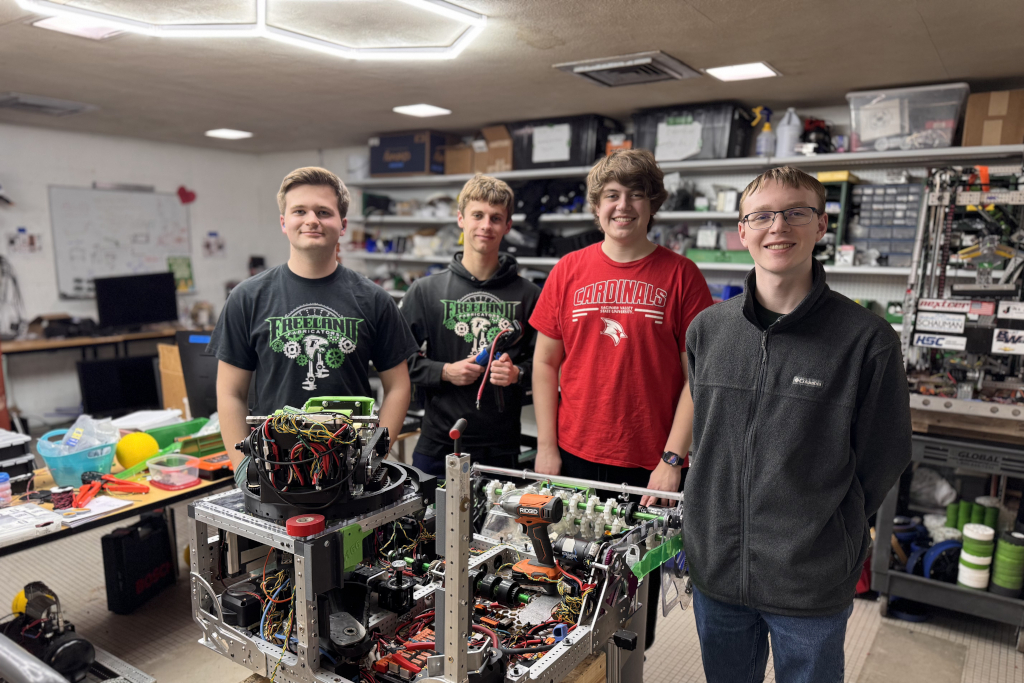
Based in Freeland, the team has earned a reputation for excellence in the high-pressure world of FIRST Robotics. Last year, they placed second in the world championship competition, an achievement that would be extraordinary for any team, let alone one from a small community. But what stands out just as much as the trophies and banners is the kind of young people this program is helping shape.
They are thoughtful. They are hardworking. They are community minded. And as six student team members made clear during a recent interview, they are deeply aware that robotics is about much more than machines.
For Braeden Oehring, a junior, the journey began with curiosity. He joined robotics in sixth grade simply because he wanted to try something new and stretch himself. Over time, that curiosity turned into purpose.
“There’s something for everybody,” Oehring says. “You don’t even have to touch the robot, and you can still develop really valuable skills and make a lot of good friends.”
That idea came up again and again as the students described the team. Robotics, they explained, is not just coding and metal parts. It is public speaking, fundraising, writing, organizing, mentoring, presenting and learning how to support one another. It is a place where students with different talents can find a role and be valued for it.
Emma Wells, a senior and one of the team’s student leaders, has seen that firsthand. She described the long hours that go into the season, from fundraising and sponsor visits to writing award essays, creating presentations and preparing for judge interviews. The work can be demanding, especially while balancing school and everyday life, but Emma believes those experiences prepare students in lasting ways.
“We learn how to get a lot of information into a very compact essay, how to answer questions on the fly and how to speak in front of people,” Wells shares. “I think everybody on this team has done some kind of public speaking.”
Those lessons carry weight. Students are learning how to think clearly under pressure, how to represent their team professionally and how to communicate with adults, judges, sponsors and community partners. In many ways, the program looks a lot like real life. It asks students to collaborate, adapt and lead.
Jake Steffen, a senior, said one of the biggest things robotics teaches is something many people do not immediately associate with engineering: soft skills.
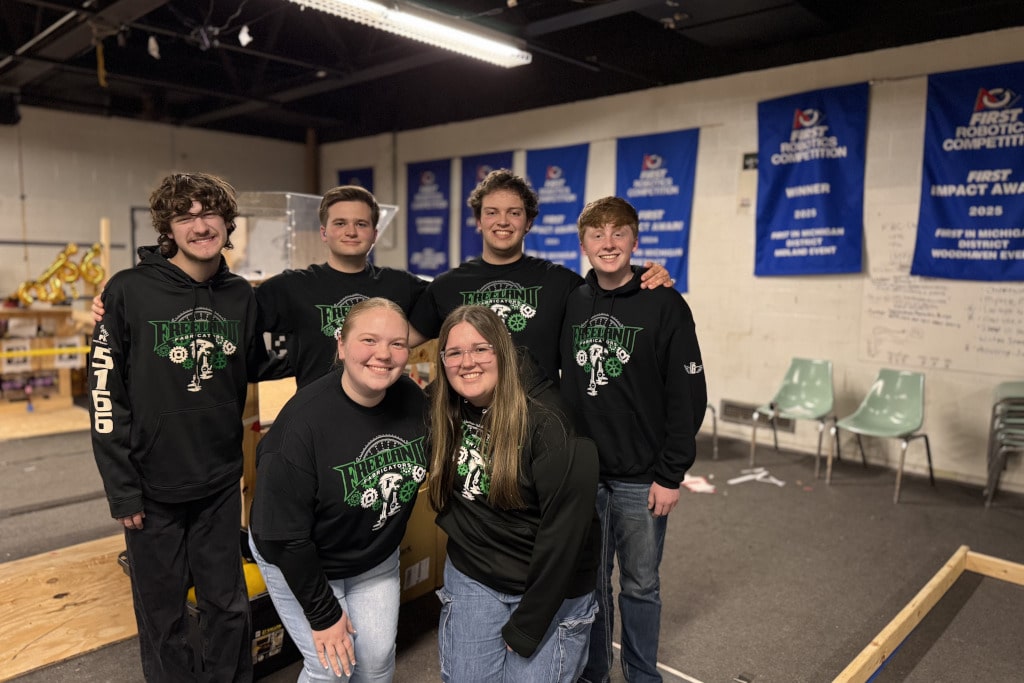
“You learn how to work with others, talk with others and make connections,” Steffen adds. “There are a lot of connections made through robotics that you can carry with you for a long time.”
That spirit of teamwork seems to define the Fabricators. Students move between sub-teams, communicate constantly during competitions and fill multiple roles when needed. A student might help with strategy, then move to scouting, then return to the pit. Another might speak with judges while others make quick repairs. It is fast-paced and demanding, but the students say it works because they trust one another.
Hannah Wells, a freshman, said one of the most important values the team carries is gracious professionalism, a phrase deeply rooted in FIRST Robotics.
“You should always be grateful for what you have and stay professional while you’re doing it,” she says.
That value shows up not only in competition, but in the team’s service to others. The Fabricators have made community outreach a core part of who they are. They volunteer with the Freeland Lions Club to help distribute food to families in need. They partner with organizations and sponsors to refurbish and donate laptops to nonprofits and youth. They visit Camp Fish Tales, where campers with disabilities can interact with the robot, make buttons and explore STEM in a welcoming environment. They participate in events designed to encourage girls to see themselves in science, technology, engineering and math.
Taylor Dombrowski, a sophomore, said one partnership with Saginaw Valley State University especially stood out. Through STEM-focused outreach events, the team had the chance to introduce hundreds of girls to robotics and science.
“It was really cool to have our station there,” Dombrowski remarks. “We reached 392 girls, and knowing you can reach that many people by just a couple events is pretty crazy.”
That outreach matters because the students understand what it means to need a place to belong. Taylor spoke with moving honesty about how robotics became that place for him. What he found on this team was not just an activity, but acceptance.
“It is a place where everyone supports you,” Dombrowski continues. “It literally gave me a purpose to stay.” It is difficult to imagine a stronger endorsement than that.
For Evan Miller, a senior, one of the most meaningful lessons has been learning how to pass knowledge on. After becoming the only student who knew how to code the team’s scouting app, he realized the responsibility that came with it. He had to teach younger students, not just complete the task himself.
“A lot of what I’ve learned in robotics is not just how to learn things myself, but also how to teach them to other people,” Miller shares.
That cycle of mentorship is part of what keeps the program strong. Older students teach younger students. Younger students grow into leaders. Knowledge is shared. Confidence grows. The team becomes sustainable not only because of technical skills, but because students invest in one another.
That mindset has helped the Fabricators weather challenges, too. Students described space limitations, long hours and the need to rebuild after a difficult season. Yet the tone in the room was never bitter. Instead, there was gratitude for the way the team had pulled together and kept moving forward.
Their success on the world stage last year was thrilling, but none of the students framed it as only a story about winning. Yes, becoming world championship runners-up was a remarkable moment. Yes, it was a point of pride for Freeland. But what mattered most to them was sharing that moment with teammates, families and partners who had worked for it together.
This is what makes the Freeland Fabricators such an exceptional group of young people. They are excelling in one of the most competitive student spaces in the world, and they are doing it without losing sight of kindness, inclusion and service. They are mentoring younger students. They are helping families. They are opening doors for girls in STEM. They are using robotics not simply to build impressive machines, but to make a real difference in their community.
And in a world that can sometimes feel heavy, there is something deeply hopeful about that.
This article is dedicated to the memory of Aiden Glaza, whose presence and impact continue to be felt by the Freeland Fabricators.
Related Articles
Ferris State taps public health dentist to launch Michigan’s first dental therapy program
Dr. Deborah Brown will lead Michigan’s first dental therapy program at Ferris State, preparing providers to improve access to routine dental care.
CDFIs help rural Michigan communities fund affordable housing, education, and support small business growth
Rural communities often experience a lack of capital access due to bank mergers, or community banks leaving their areas. CDFIs step in to bridge the gap by providing crucial capital, workshops, and referrals to rural communities — funding affordable housing, high-quality education, and community development with small business growth.
Northern Michigan school goes ‘no screens’ to boost literacy. Is it the right approach?
Mesick Elementary School’s decision to cut screens has attracted the attention of neighboring school districts.