
Thompsonville trailhead and campground project chugs along
The project aims to bring some life back to Thompsonville, a former railroad stop.
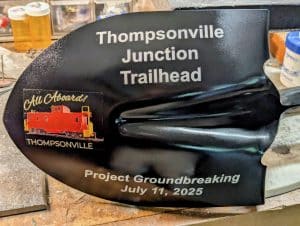
The tedious underpinnings of permits and septic fields, deeds and land surveys are finally in place, the i’s are dotted and t’s crossed on grant award documents, and the formal groundbreaking has taken place.
Now, it’s full steam ahead on a revitalization project at the corner of Thompson Avenue and Michigan Avenue in Thompsonville.
The project aims to keep the once-bustling railroad junction of Thompsonville on the map — this time as a stop for hikers, bikers and tourists exploring Northern Michigan.
The goal: A village trailhead and campground, both designed as a nod to the area’s history, to complement a world class rail-to-trail, says Charles Kraus, president of the board of the Thompsonville Area Revitalization Project.
As Kraus told the crowd at this summer’s groundbreaking: “136 years ago, a railroad junction was carved out of the primal forests at this very location. That junction significantly impacted the growth and prosperity of Northwest Michigan and the Thompsonville area community in particular.”
What’s happening: A project designed to draw day visitors and campers to Thompsonville is chugging along. Plans unveiled during a July ceremony at George W. Sharp Park show a visitors pavilion and a modern campground at the trailhead, located along the southeast end of the 22-mile Betsie Valley Trail in Benzie County.
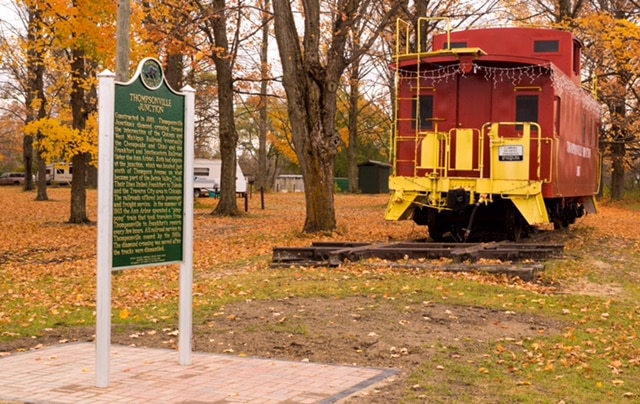
The pavilion, Kraus says, will feature a bike rack, a bicycle repair area, an upright fountain and bottle filler, and other amenities. Landscaping and paved walkways will highlight the park’s signature red caboose, the original junction rail track “diamond,” and a state historic plaque explaining the village’s history as an important railroad hub.
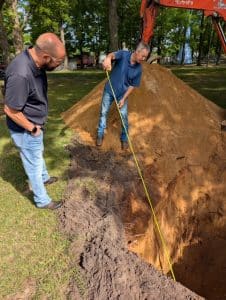
A second phase: The second phase of the project will focus on upgrading an existing 10-site rustic campground adjacent to the trailhead. Every campsite will have 50-amp electrical service, Kraus says, and two of the upgraded sites will comply with the American with Disabilities Act with concrete pads. The campground’s old pit toilets are gone; campers will use the four restrooms and two showers in the visitors center.
The campground is closed for construction but upon completion, the pavilion and the campground will be open seasonally from spring to late fall, and construction on both will be well underway by mid-summer 2026, Kraus says. The visitors center will likely be open for use by late summer. The campground should be ready for campers by the 2027 season, he says.
The timing works nicely— the Betsie Valley Trail, a popular state-owned rail-to-trail, is undergoing upgrades as well, through the efforts of other nonprofit groups, Kraus says. “Their eventual goal is to pave the trail all the way from Thompsonville to Beulah,” Kraus says. “So we would have a first-class, world-class trail, with our trail head, right next to the campground.”
By the time work is finished, Thompsonville will again be a perfect stopover between Elberta, Frankfort, Beulah, and the nearby Crystal Mountain Resort.
Back story: The projects are positioned to revitalize that once bustling community of Thompsonville, population 450, which in its heyday was a lumbering hub and railroad junction of two main freight and passenger lines. “After the creation of the railroad hub,” Kraus says, “Thompsonville grew and for a brief moment in history it flourished.
The Thompsonville Area Revitalization Project began in late 2020, and much work to date has been laying the groundwork— fundraising, retrieving lost records, seeking grant funding, surveying and creating a septic field for modern services.
Current historical exhibits at the site include the diamond-shaped section of the crossed tracks, a state historical plaque, and an old caboose, a remnant of the great Northern line, repainted to cover graffiti from its idle years. The interior of the caboose may eventually be restored as a future project, Kraus said.
Funding: Phase one of the current project is funded in part by a Michigan Economic Development Corporation Impact100 grant as well as funding from the Grand Traverse Regional Community Foundation, other awards and private donations. Phase two is financed by a Michigan Department of Natural Resources Trust Fund Grant to the village of Thompsonville; TARP is supplying the required match for the grant. Additional funding has come from the Grand Traverse Regional Community Foundation, Benzie Sunrise Rotary, the U.S.Department of Agriculture, and Rotary Charities of Traverse City.
What happens next: The first steps will be the demolition of an existing vacant concrete block building near where the pavilion will be located. Future projects may include restoration of the caboose interior. “Every time there’s a hurdle,” Kraus says, “we sit down, put our heads together, and say: ‘How can we handle this? What can we do? How can we move forward on this?’ Because this is a great idea, and it’s going to do great things for Thompsonville.”
Donations: To donate to the project, click here.
Related Articles
CDFIs help rural Michigan communities fund affordable housing, education, and support small business growth
Rural communities often experience a lack of capital access due to bank mergers, or community banks leaving their areas. CDFIs step in to bridge the gap by providing crucial capital, workshops, and referrals to rural communities — funding affordable housing, high-quality education, and community development with small business growth.
U.P. tour helps historical communities build a stronger economic future
Michigan Municipal League travels north to share resources for small business development.
Michigan Municipal League collaborates, educates, and advocates for the state’s communities
Michigan Municipal League shares innovative programs, fosters collaborations, and connects communities with resources.