
Centuries-old U.P. forest offers scientists a direct link to Michigan’s past
Lake Superior’s newly documented, centuries-old red pines feature gnarled “alligator bark” and historical fire scars that provide scientists and historians with a rare, direct link to indigenous land management practices.
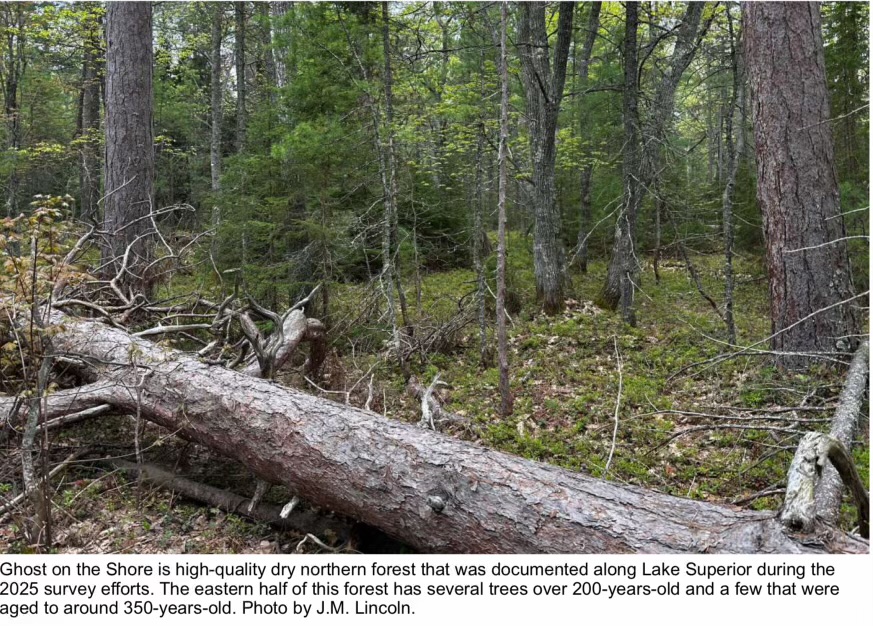
Against all odds, a spectacular pocket of ancient forest managed to escape the crosscut saws of 19th-century lumberjacks in the U.P.
Scientists are celebrating the discovery of more than 100 acres of old-growth red pine on state land north of Newberry—with some of the trees clocking in at 200 to 400 years old.
Tipped off by a local state forester, conservation scientists with the Michigan Natural Features Inventory (MNFI) hiked into the wilderness to investigate. Registered in the MNFI database as the “Ghost on the Shore,” the site exceeded every expectation.
“Our hopes were up as we hiked in,” says Jesse Lincoln, a lead MNFI ecologist with the Michigan State University Extension, “and wow—it didn’t disappoint.”
What’s happening: Located within the eastern U.P.’s Newberry Forest Management Unit, these red pines grow along the North Country Trail on Lake Superior’s sand dunes. Unlike the massive specimens at Hartwick Pines near Grayling in the lower peninsula, their beauty lies in gnarled features shaped by centuries of harsh winter winds and periodic fires. At eye level, the trunks are covered in smooth, large plates called “alligator bark.” High in the canopy, thick lateral branches flex like a bodybuilder’s arms, bearing the brutal scars of lake storms and fire resin.
“You know they’re growing on the shore, and this is where the storms hit like a freight train, “ Lincoln says. “You get the canopy definitely brutalized by winter storms, extreme snowfall, and they start to get a lot of character.”
These old red pine trees also bear the unique evidence of fire— the species’ trauma response to fire is to pump resin through the tree’s vascular system, leaving fire scars on the base of the old trees.
Why the old trees matter: Spared from 19th-century lumber barons, these trees hold immense scientific and historical value. Fire scars offer clues about the landscape’s past, including the practices of Indigenous peoples near the Two-Hearted River. Native cultures used managed fires to promote berry growth and harvested red pine sap to waterproof lodges and canoes. This makes the forest a rare, direct link to historical land management.
“You can see these culturally modified trees where they would pull this bark off and harvest the resin,” Lincoln says.
This makes the forest a rare, direct link to historical land management.
“I’ve got colleagues that are working all around the state, especially in that part of the U.P., to reconstruct the fire history to show exactly how people were using fire to influence the landscape,” Lincoln says. “This stand represents a forest that was not caught in the late 1800s when the lumber barons came through and really peeled the face off of the state.”
What’s next: Scientists will use GIS modeling and historical surveyor notes to locate other fire-dependent natural communities. Researchers will also collaborate with Indigenous groups to document traditional controlled burns. Because red pines require fire to clear brush and help seedlings root, this historic data will guide future managed burns to ensure the forest continues to thrive.
Recalling his arrival to check the site, Lincoln says, “Once we kind of crested that last dune— it’s sort of a series of dune ridges—and we just started seeing these big, irregular tops with the large diameter lateral branching and the really big platey bark, then it just kept going, it just kept going, and it kept going.
“It became clear, he says, “that this was special.”
Related Articles
From Abandoned Slope to Natural Sanctuary: Sugar Loaf opens a vibrant new chapter
The former ski resort begins a new life with the unveiling of its brand-new Summit Trail and breathtaking 360-degree autumn views.
Preserving the Great Outdoors: Millions targeted for state parks and public lands
Michigan’s state parks and public lands benefit from millions of dollars in the state’s 2027 budget and millions of dollars in Trust Fund grants.
$2 million federal grant boosts Benzie and Grand Traverse trail infrastructure
A $2 million federal investment in MDOT projects will pave the final stretch of the historic Betsie Valley Trail in Benzie County and expand Grand Traverse County’s 3-Mile Trail network, driving regional transit and economic growth.