State DNR launches new $7 million research vessel on Lake Michigan
The Michigan Department of Natural Resources has debuted the RV Steelhead, a new $7 million, 66-foot state-of-the-art floating laboratory moored in Charlevoix to conduct vital fisheries research across Lake Michigan.
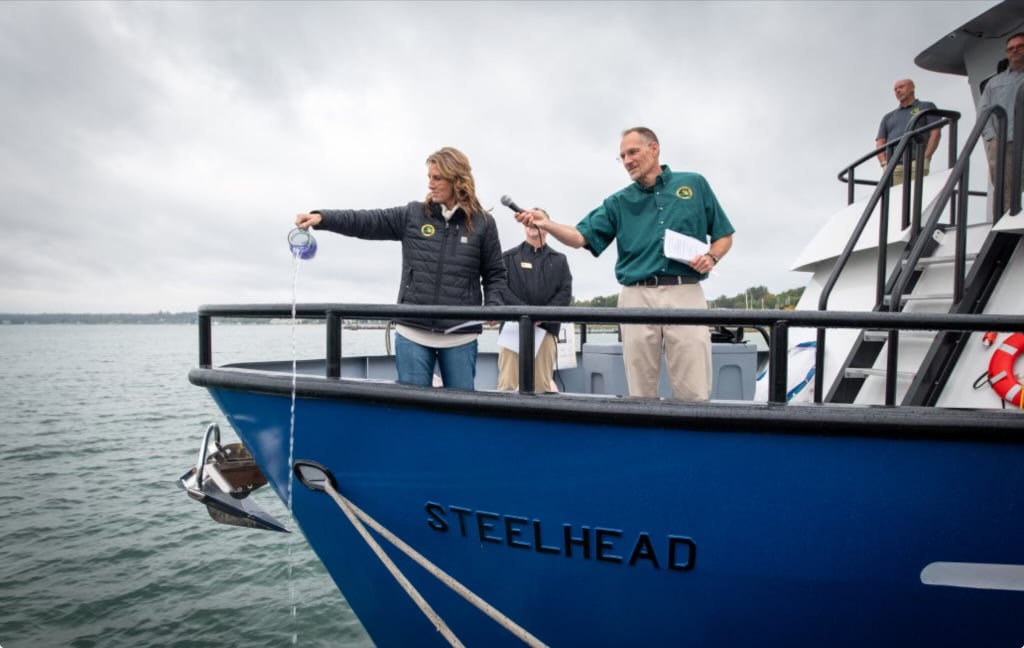
Scientists monitoring Lake Michigan fisheries have new research digs— a 66-foot, steel-hulled vessel christened Research Vessel Steelhead, a nod to its 58-year-old predecessor Survey Vessel Steelhead.
The new craft will be moored in Charlevoix along Lake Michigan’s eastern shoreline.
“Lake Michigan is one of the largest freshwater lakes on the planet, “ says Randy Claramunt, who is the chief of the Michigan Department of Natural Resources Fisheries Division. “The RV Steelhead and crew will serve as the state of Michigan’s primary means to collect data and inform fisheries management decisions on this Great Lake.”
What’s happening: The new vessel provides safer, more efficient operations for the state Department of Natural Resources (DNR) crew members. This vessel is the largest of the state’s four Great Lakes research vessels, which include others dedicated to Lake Superior, Lake Huron, and Lake St. Clair. The Steelhead, christened this fall by DNR Deputy Director Shannon Lott, is the only one equipped to house its crew overnight.
What makes it special: The RV Steelhead was designed by Boksa Marine Design and constructed by Moran Iron Works in partnership with Superior Boats. Funding for this $7 million project was provided by appropriations in state budget bills and grants from the Great Lakes Fishery Trust. Key features of the new vessel include:
- A premium navigation equipment package to improve accuracy, safety and operational effectiveness on the water.
- State‑of‑the‑art sampling equipment allowing the crew to perform surveys and collect data with increased precision and reliability.
- A streamlined fish‑processing design supporting efficient, organized and high‑volume biological sampling during field operations.
- A SeaKeeper gyrostabilizer, providing a significantly safer and more stable work platform for crews, especially in rougher conditions.
- A multiuse stern platform to assure safer and easier access to the water’s edge — supporting a wide range of sampling and deployment activities.
- A bow thruster allowing for more precise maneuvering in tight harbors, research sites and challenging wind or current conditions.
- An incorporated solar-charging system, supporting improved energy efficiency and reducing reliance on conventional power sources during operations.
“These features reflect our broader goal of ensuring our field teams have the safest, most capable tools available to carry out the essential work of fisheries research and resource management,” Captain Pat O’Neill says.
The back story: As the research vessel serving Lake Michigan, the RV Steelhead will be vital for survey work, including the spring gill net survey, lakewide acoustic forage fish survey and the bottom trawl survey, which monitor species including lake whitefish, lake trout, burbot, yellow perch and prey fish, such as alewife and rainbow smelt, as well as invasive species. The survey season usually runs from April to November.
Each research vessel has a permanent staff of four to operate the craft itself, a captain, an assistant captain, and usually two fisheries technicians. They may be joined by others, such as a research biologist or a visiting professor from a university.
“We’re definitely looking forward to the next several years on that vessel,” says Patrick Hanchin, manager of the DNR Charlevoix Fisheries Research Station
Related Articles
The Giving Tree
A brief conversation about chestnut trees sends a hospice nurse down a rabbit hole that changes his life.

Chasing Ice: Unpredictable trail and big crowds await racers at the annual Iceman Cometh
Driven by a vibrant community spirit and an unpredictable course, the annual Iceman Cometh Challenge brings over 16,000 visitors to Traverse City.
Michigan species at risk after federal rollbacks to endangered species protections, advocates say
The Trump administration narrowed Endangered Species Act definitions of “harm” and “take” by removing habitat degradation protections and limiting violations to intentional killing. Advocates warn this imperils 26 protected species in Michigan.